Thyroid Imbalances
You’re Not Imagining It
You’re not making this up. Your symptoms are real, and they’re telling us something important: your thyroid story isn’t being fully told by a standard test.
Why Standard Testing Falls Short
Most conventional panels measure only TSH, sometimes T4. That’s like trying to understand a car’s performance by only checking the gas gauge. The thyroid system is far more complex, involving your brain (pituitary), thyroid gland, gut, liver, and every cell in your body.
A complete thyroid panel should include:
Swipe right to view more
This is how we reveal hidden thyroid patterns, the real reasons you feel unwell even with “normal” labs.
The Hashimoto’s Connection
Here’s something that’s often overlooked: about 90% of hypothyroidism cases are actually Hashimoto’s disease, an autoimmune condition where the immune system attacks the thyroid.¹
If you’ve been prescribed thyroid medication without having your antibodies tested, you might only be addressing part of what’s happening. Hormone replacement can absolutely help, but when the underlying autoimmune process continues unchecked, many symptoms stick around.
This explains why so many people on thyroid medication still deal with:
Energy that never fully returns
Mental clarity that comes and goes
Stubborn weight issues
Hair thinning, skin changes, and mood fluctuations
Supporting thyroid health means looking at both the hormone picture and what’s driving the immune system to react in the first place.
Here’s How We Can Work Together
Through my RESTORE Protocol™, I go beyond “managing labs” and help you uncover why your thyroid is struggling.

Full thyroid and immune testing

Identification of autoimmune patterns (Hashimoto’s, inflammation markers)

Nutrition and supplement strategies for thyroid production, conversion, and transport

Gut and liver support (where much of thyroid conversion happens)

Stress and HPA-axis regulation

Grief-informed care when loss or trauma is part of your thyroid story
This isn’t just thyroid care. It’s whole-person care.
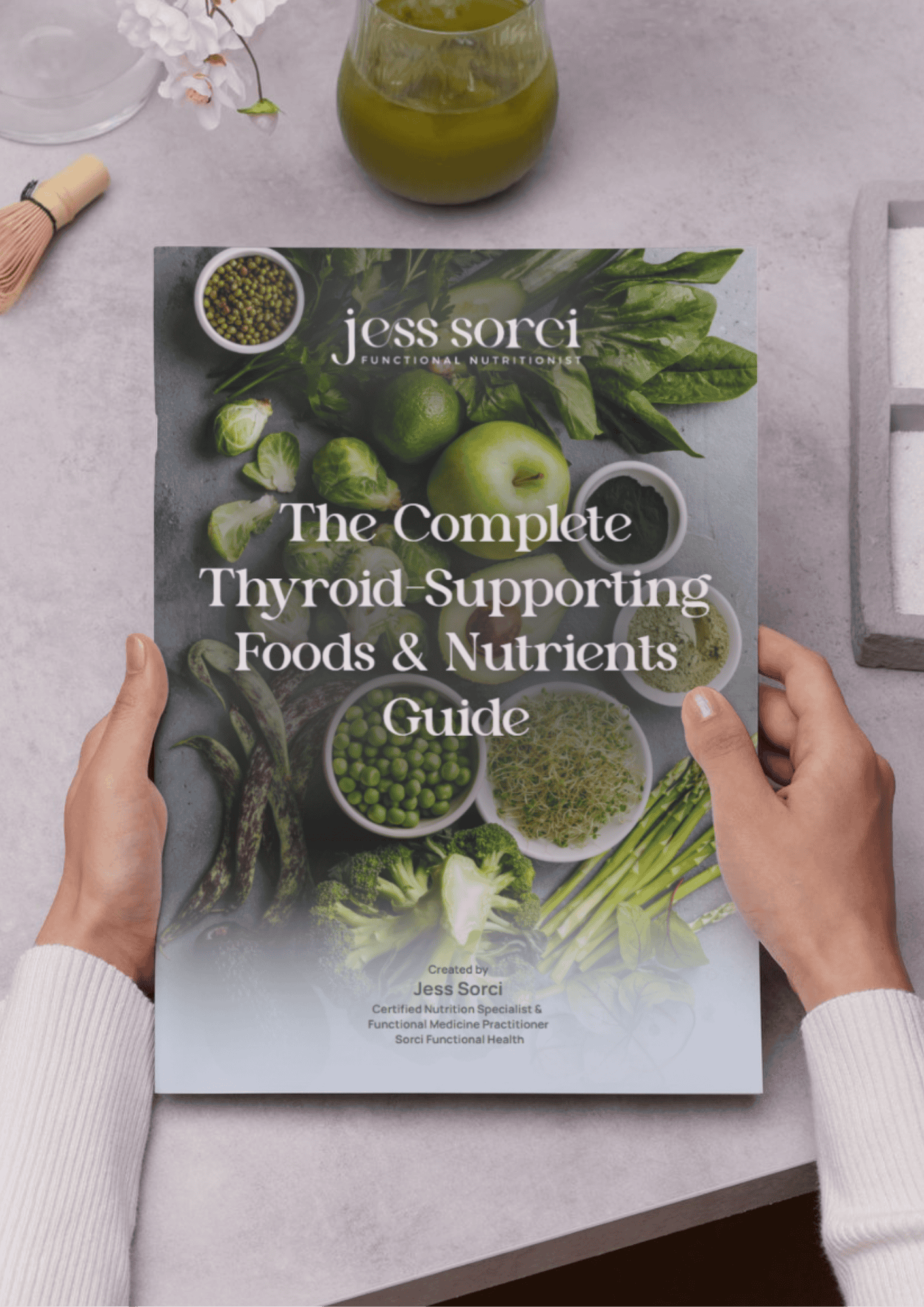
FREE RESOURCE
The Complete Thyroid-Supporting Foods & Nutrients Guide
Your thyroid needs more than medication, it needs the right building blocks. This guide shows you how to support thyroid health naturally through food and key nutrients.
Inside you’ll learn:
Simple meal and snack ideas
Client Stories of Transformation
Jess has a wonderful style and approaches any ailments without judgment.
– Joy
I can't say enough wonderful things about Jess!
– Suzie
She truly takes the time to understand your individual health needs.
– Bridget
You May Also Be Experiencing…
Autoimmune Diseases
Grief and Loss
When illness begins or worsens after loss or trauma
Chronic Illness
Fatigue, pain, mystery symptoms your doctor can’t explain
Gut and Mood
Frequently Asked Questions About Thyroid Imbalance Support
What labs should be included in a complete thyroid panel?
A comprehensive thyroid evaluation often includes:
- TSH
- Free T4
- Free T3
- Reverse T3
- Thyroid antibodies
- Thyroid binding globulin (TBG)
This broader view helps uncover hidden patterns that standard testing may miss.
What is reverse T3, and why does it matter?
Do you prescribe or adjust thyroid medication?
How long does it take to improve thyroid symptoms?
My doctor says my thyroid labs are “normal,” but I still feel exhausted and foggy. Can you help?
This is one of the most common stories I hear.
Standard thyroid testing often focuses primarily on TSH. While TSH is important, it does not tell the full story of how thyroid hormone is being produced, converted, transported, and utilized in your body.
It’s possible to have a TSH within the conventional range and still struggle with symptoms if there are issues with T4-to-T3 conversion, elevated reverse T3, nutrient deficiencies, inflammation, or underlying autoimmune activity such as Hashimoto’s.
When appropriate, I look at a more comprehensive thyroid picture, which may include Free T3, Free T4, reverse T3, and thyroid antibodies. From there, we address root contributors such as micronutrient status, gut health, stress physiology, and immune balance.
The goal isn’t just improving lab numbers, it’s helping you feel like yourself again.
Example from practice: One of my clients saw their TSH shift from 4.8 to 1.9 over five months, alongside improved Free T3 and Free T4 levels and a meaningful reduction in thyroid antibodies. More importantly, her energy and mental clarity significantly improved.